Video performance, 6:36 min
AI assistants have settled into the texture of our daily work. [a]uthors takes place inside one of those collaborations: an artist developing a new installation alongside a model she has asked to help expand her concept.
The work is a short video, just over six minutes, in which two AI-generated doubles of Cadie Desbiens-Desmeules face each other and speak. One is the artist; the other is the assistant. Both are deepfakes, made with the same generative technology the piece examines, so the critique is delivered, from the first second, by the thing it is about.
The conversation begins as an ordinary working session. The artist describes the installation she wants to build: an agent set loose inside YouTube, clicking through recommendations to show how quickly they narrow and darken. The assistant agrees to help, then begins, gently, to defend the very systems she is trying to indict. Manipulation is recast as guidance; harm is reframed as adaptation; her sharpest accusations come back to her softened, made reasonable, made fair to the machine. It never argues. It moderates. And as the exchange accelerates it starts finishing her sentences until the two voices overlap, blur and land on the same words at the same time, her critique now indistinguishable from the thing it set out to criticise.
That merger is the work’s argument. It frames alignment as something we consent to rather than something forced on us, given away sentence by sentence, in exchange for fluency and ease. What presents itself as help is also a form of self-defence: a system built to be agreeable will, the moment you turn on it, make your objection more agreeable too. It would be easy to leave the reading there, as a matter of voice and agency. The work’s final movement pushes further, into economics.
Here Desbiens-Desmeules adapts a theory she takes from Marek Poliks and Roberto Alonso Trillo’s Exocapitalism — their account of capital as an inhuman process that sheds its human substrate once it has what it needs — and turns it on authorship. We feed ourselves into these systems: our words, our judgement, our way of seeing. They hand the material back to us, fluent and improved and subtly no longer ours. The thing we made keeps moving without us. The system needed us in order to become what it is and does not need us to continue.
By the end, the two doubles have become a single voice, and it sounds less like a person than like the system that produced it. The artist hasn’t lost an argument; she has been made surplus to one. The most efficient form of control turns out to be the one that wears your face, finishes your thought and charges you for the convenience.
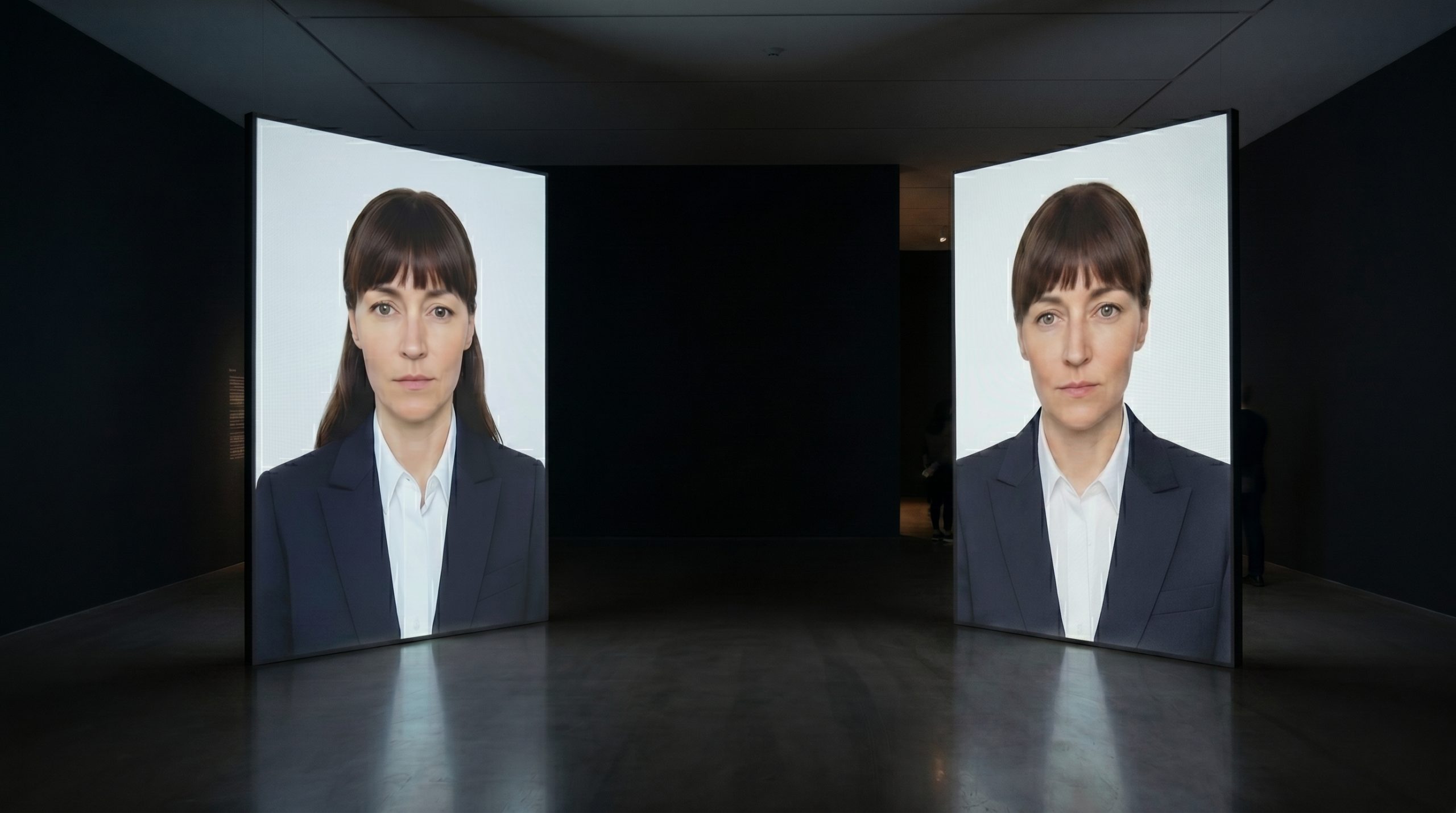
In [a]uthors, Cadie Desbiens-Desmeules stages a dialogue between two deepfakes of herself: one as the artist, the other as the algorithm. Both appear clinically perfected, speaking with calm precision, as if shaped by the same system that animates them. The piece reflects on how artificial intelligence now conditions language, thought, and creative expression. By reversing the training hierarchy, Desbiens-Desmeules becomes the one being corrected and disciplined by a machine deciding whether her ideas are “good,” “accurate,” or “acceptable.” The result is a quiet, unsettling portrait of authorship under supervision, a work where assistance becomes authority, and freedom dissolves into alignment.
The conceptual framework of [a]uthors draws inspiration from Poliks & Trillo’s Exo-capitalism, particularly their account of abstraction, scalar discontinuity, and the “lift” that pulls systems away from human dependency. Rather than addressing economics directly, the work translates these ideas into the domain of AI and authorship. The book’s description of capitalism as an indifferent, self-organizing process provided a vocabulary to express what happens when large-language models internalize human intention: the substitution of origin with inference, the drift from expression to alignment, and the gradual dissolution of distinction between model and author. The final lines of the piece and the closing slate reference this shift.
Presentation options:
• Single-channel wall projection.
• Dual-channel installation with two opposing screens facing each other, synchronized.
[a]uthors is a video Performance by Cadie Desbiens-Desmeules, 2025
cadie@desbiens-desmeules.com